
Laxmi Rani
Counseling Psychologist | Mental Health Counselor | Relationship Counselor +4 more
New
17+ yearsOnlineGhaziabadEnglish, Hindi
Bookable sessionsExperiencedFrom ₹1000AnxietyDepressionStress Management
Compare trusted psychologists by expertise, care mode, and location. Choose confidently and book support that fits your life.
Not sure what you need?
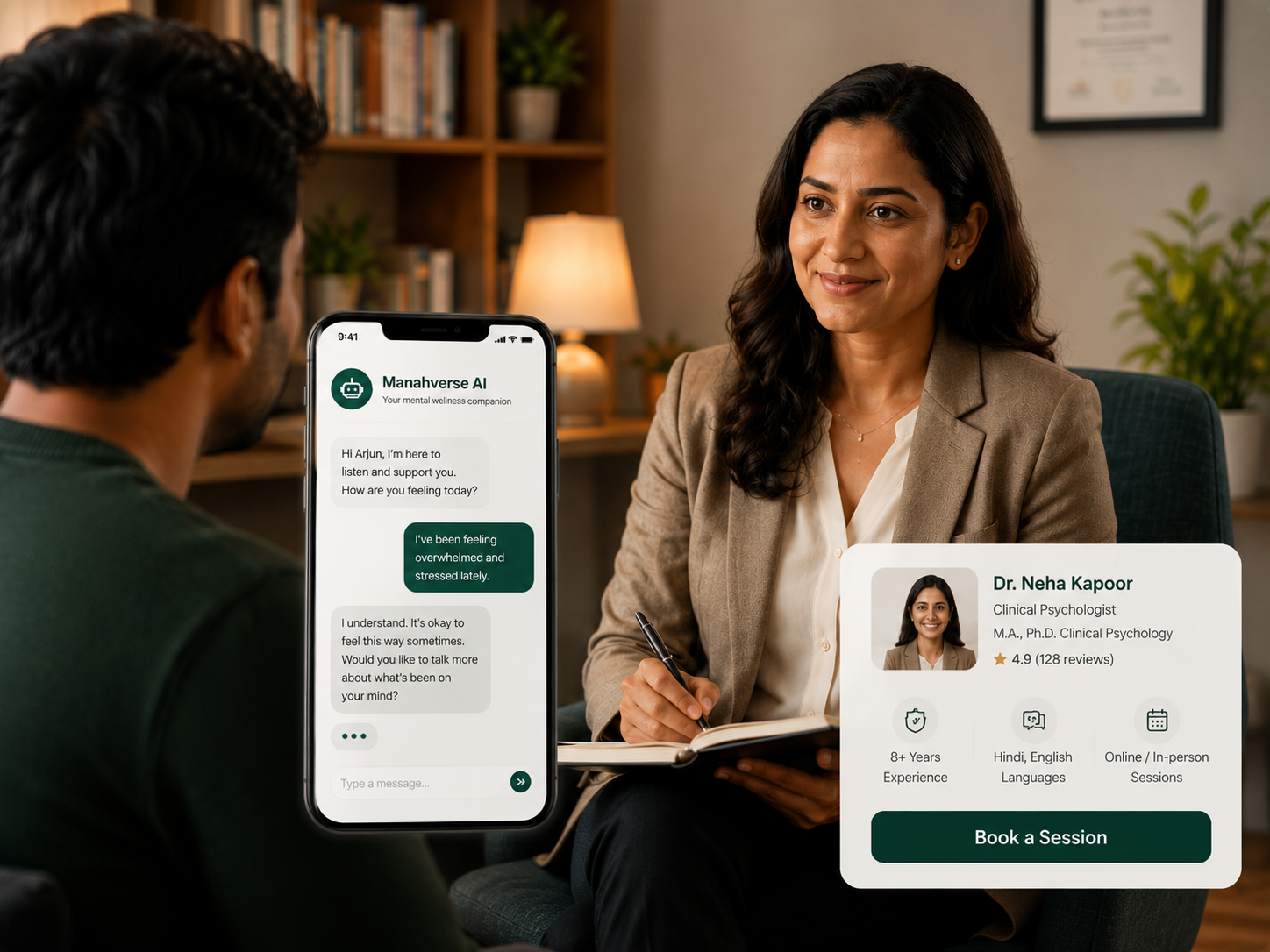


Care on your terms
Online, in-person, or a flexible mix
Professional care types
Explore professional formats by focus area, then compare certified mental health practitioners who provide it.
Upcoming workshops
Join focused, supportive sessions on the concerns that shape everyday wellbeing.
Self-Care & Community
Whether you want a private reflection diary or you are a professional wishing to share insights, we have spaces built for you.
Reflect on your day, track your moods with emojis, record gratitude, and log self-care goals. Access psychological prompts designed to guide your emotional introspection. Completely private.
Registered psychologists and practitioners can author educational articles, respond to public community forums, and guide thousands of clients seeking mental well-being advice.
Top profiles
Recommended by profile quality, bookable sessions, verified reviews, trust signals, and marketplace activity.
Counseling Psychologist | Mental Health Counselor | Relationship Counselor +4 more

Child Psychologist | Rehabilitation Psychologist | Career Counselor +9 more
Licensed psychologist
Counseling Psychologist | Relationship Counselor | Mental Health Counselor

Counseling Psychologist | Mental Health Counselor | Life Coach +12 more

Counseling Psychologist | Relationship Counselor | Family Counselor +1 more

Counseling Psychologist | Career Counselor | Mental Health Counselor +13 more
Browse by concern
These areas of concern are drawn from the expertise of verified professionals currently on Manahverse.
Care near you
Discover verified professionals in active Manahverse locations, with online options available beyond city limits.
Mental Health Insights
Read expert advice, guides, and therapeutic perspectives on various psychological topics.
As a psychologist, I have observed we as an individual always think that we are right and the person whom I am having differences is completely wrong but if we are going to follow this mindset pattern then what do you think true relationship going to be sustain? Ofcourse not!! At some point we really need to understand each other's point of view, give space and then communicate so that both the parties can come on a same page and that is the every day churning through which good relationship can be sustain. Sometimes, the harshest words can break us but if we learn to take nothing personally and may be try to take pointers what is important for us and leave the rest, that is where human revolution happens. Thanks & Regards Simran Jaiswal (Psychologist)
simran jaiswal
MSc Psychology
Work can be rewarding, but constant deadlines, expectations, uncertainty, and pressure can gradually take a toll on emotional well-being. You may find yourself feeling anxious before work, tired even after resting, overwhelmed by responsibilities, or frustrated by situations that once felt manageable. Workplace stress is not simply about having a busy day. When stress becomes persistent, it can affect concentration, sleep, relationships, motivation, and overall health. Recognising these emotional signals early is an important step toward preventing prolonged exhaustion and burnout. Effective stress management begins with awareness. Taking regular breaks, setting realistic boundaries, prioritising tasks, practising mindful breathing, maintaining supportive relationships, and seeking professional help when needed can make a meaningful difference. Emotional well-being at work does not mean eliminating pressure; it means developing healthier ways to respond to it. Creating workplaces where people feel heard, respected, psychologically safe, and supported can help employees move from simply coping to genuinely thriving.

Dr. Sachitra Chakravorty
PhD in Psychology
Have you ever felt like you put away work because it felt too much? Sometimes it feels like you’re repeatedly recalculating the route instead of actually driving. The freeze mode, or that feeling when you feel overstimulated? It feels draining and impossible; hence, putting the task away or avoidance makes it the best option for you to feel at ease again. Shame exacerbates it even more. Fear of judgement, exhaustion/burnout, uncertainty, or even perfectionism come as hurdles to completing the tasks. Why do we procrastinate after all? Are you lazy as the “Indian parents” say? Definitely not! All your life, you have been misunderstood, and I know that feeling; you begin to feel alone, as though nobody understands you. Questions arise: what if you do not succeed or reach that goal due to uncertainty? You get stuck in the avoidance cycle. That brings me to the next question—what really happens when you avoid? A sense of anxiety comes up—fixation on the worst-case scenario, doubts about ability to cope, palpitations, overthinking, and irritability following that avoidance due to the anxiety spurs. Hence, you do not do the task at all (school homework, work, etc.), so a sense of relief comes in; however, that relief is only temporary, and the anxiety/shame intensifies, and you judge yourself even more. Little do we know that this actually makes you stay stuck in the loop and worsens it. Moving on, you must be wondering—how do I cope with this? Yes, it is hard and requires grave attention and consistency to break the pattern of procrastination. Perhaps, you would’ve heard about SMART goals (Specific, Measurable, Achievable, Relevant, and Time-Bound). Break your task into small parts and learn to take the help needed (whether it be financial, social, or even emotional) and delegation, but alongside making an accountable promise to yourself that you will trust yourself and take breaks too, but complete this. I feel it is very important to notice how you talk to yourself at that time—is it the loud critical voices? How do you feel in your body at that time? Tight stomach knots, tense shoulders, heavy chest? Pause and breathe first—it can be through diaphragmatic breathing, box breathing, butterfly hug, or any somatic exercise that eases you. Afterwards, knowing what you are telling yourself at that time, changing the words or rephrasing, and of course not forgetting—social support plays an integral role as well. Last but not least, what is stopping that little girl/boy within you from trusting yourself again? How can you connect to that inner child in you and build that trust again? These are important questions you must ask yourself today! Take that step for yourself; you deserve the best.

Diya Sharan
MA in Psychology